
The Supreme Court resumed hearing pleas challenging the Maharashtra Speaker's decision regarding the Eknath Shinde-led Shiv Sena MLAs and the Election Commission's recognition of the Shinde faction as the "real" Shiv Sena. Senior advocate Neeraj Kishan Kaul, representing the Shinde camp, argued that the EC has jurisdiction under Article 324 to examine a party's democratic character and organisational structure, especially when the Thackeray faction's constitution was not registered with the poll panel. He emphasised that the Shinde faction's case is based on a split within the political party, not just its legislative wing, citing cadre discontent. The hearing remains inconclusive.

Supreme Court Justice Ujjal Bhuyan critically examined police conduct in India, raising serious concerns about alleged assaults on protesters, custodial torture, and the urgent need for comprehensive police reforms to uphold human rights and the rule of law.

The question for the next 20 years is not whether India can become a $5 trillion or $10 trillion economy. Those are attractive targets, but the real question is whether India can create enough productive jobs, educate its children properly, make its cities liveable, and give hundreds of millions of people a substantially better life, asserts Ramesh Menon.

Union Minister Ramdas Athawale stated that opposing reservation is unconstitutional and that the policy would be given up if casteism is eliminated. He highlighted the historical context of reservations for SC/ST and OBCs, and the Modi government's EWS quota. Athawale also criticised the opposition, praised government achievements, and discussed various welfare schemes and infrastructure projects in Chhattisgarh.

'If elections are held with honesty you will see their defeat.'

Discover the latest star-studded OTT releases this week, featuring Akshay Kumar's Welcome to the Jungle, Vijay's Jana Nayagan, and a diverse selection of regional and international films and series across major streaming platforms.

An 'illegally' constructed mosque within the Saharanpur district collectorate complex was demolished following a court order, drawing strong condemnation from opposition parties who accused the government of engaging in 'politics of hate' and undermining social harmony.
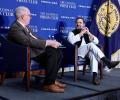
Asserting that Indian democracy is a "global public good", Congress leader Rahul Gandhi has said that its "collapse" will have an impact on the world and is not in America's national interest.
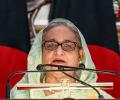
India has distanced itself from former Bangladesh prime minister Sheikh Hasina's recent media interaction in New Delhi, stating it played no role in the event nor endorsed her comments regarding the Bangladesh government. This comes after Bangladesh expressed outrage over the permitted interaction, which saw Hasina announce her determination to return to Bangladesh to restore democracy.

Underlining that students are the "architects of India's future," President Droupadi Murmu on Friday said the government is taking comprehensive steps to reform public examinations to completely curb paper leaks and unfair means, making the system transparent, secure, and trustworthy.

The Tamil Nadu Assembly has adopted a resolution, moved by Chief Minister C Joseph Vijay, urging the Union government to permanently fix the Lok Sabha strength at 543 and implement 33 per cent women's reservation by 2029. The resolution also opposes delimitation that could disadvantage states successful in population control.

Congress leader Rahul Gandhi has written to Jharkhand Chief Minister Hemant Soren, urging him to personally meet with student representatives protesting irregularities in state recruitment examinations. Gandhi stressed the legitimacy and peaceful nature of the students' demands, highlighting the Congress party's support for their right to protest.

Bangladesh has requested India to create a "conducive environment" for Prime Minister Tarique Rahman's potential visit to New Delhi for the BRICS summit, linking it to their demand for the extradition of former prime minister Sheikh Hasina. This comes amidst strained relations following Hasina's media interaction in New Delhi, which Bangladesh deemed offensive, and her subsequent death sentence in absentia for "crimes against humanity." India maintains that the extradition request is under examination and that it had no role in Hasina's media event.

Few leaders since Independence have been able to establish such a direct connection with the electorate or shape the national conversation to the extent that Narendra Modi has done over the past decade, points out former Union minister Dr Karan Singh.

In her address to the nation on the eve of the country's 80th Independence Day, the president stressed that just as government and society remain united to ensure national security, everyone must contribute through joint and concerted efforts to safeguard the present and future of students.

A meeting of Tamil Nadu MPs, led by Chief Minister C Joseph Vijay, unanimously decided to oppose the Union government's proposed delimitation exercise, demanding its complete withdrawal and an extension of the delimitation freeze for another 25 years.

When dialogue fails, protest becomes inevitable.
In a democracy, protest is often the only language left once institutions stop listening, explains Ramesh Menon.

Former India cricketer Sanjay Manjrekar has voiced his support for the ongoing student protests against exam paper leaks, characterising it as a "revolt against feeling of suppression in a democracy." His comments follow similar calls from other prominent sports personalities like Sachin Tendulkar and Shubman Gill for lasting solutions. Students are demanding the removal of Union Education Minister Dharmendra Pradhan, while Prime Minister Narendra Modi has assured steps to protect student interests amidst the protests, which recently saw a 'Sansad Chalo' march met with police action.

Jammu and Kashmir Chief Minister Omar Abdullah has renewed his call for the restoration of special status and statehood to the region, asserting that the decision to accede to India 80 years ago was correct. He highlighted the importance of upholding India's federal structure and suggested that if Article 370 hadn't been revoked, PoK residents might be seeking reunification. Abdullah also criticised centralised governance models, arguing they erode state autonomy.

RSS chief Mohan Bhagwat stated that a true Hindu believes in the unity of humanity and that all religious paths lead to the same goal, asserting that 'if any Hindu thinks that there should be no Muslim in Bharat, he will not remain Hindu'.

India's position appears to be anchored around three red lines: Hasina's safety and the guarantee of a fair trial; assurances that Bangladeshi territory will not be used for activities hostile to India; and the restoration of an inclusive democratic process in Bangladesh.

Who is running the show in Dhaka? This kind of flip-flop, culminating in a last-minute decision to skip a maiden visit, can happen only when the remote is in the hands of one of the competing lobbies within the BNP -- one that appears determined to play a game of chess with India.

At the end of this journey, no matter now it ends, these youngsters will know something essential about the Indian government, the Indian judiciary, the Indian media, the Indian police, the Indian laws and indeed about Indian society, asserts Aakar Patel.

The Cockroach Janta Party (CJP) has called off its 36-day agitation following the resignation of Education Minister Dharmendra Pradhan, who stepped down amidst widespread protests over irregularities in the exam system and the NEET paper leak. The government also agreed to the CJP's demands for 1 crore compensation to families of students who died by suicide and no action against protesters.

'After more than 12 years in power, he has been forced to retreat under public pressure. The education minister's resignation is the biggest political climbdown of his government so far.'

It was left to an incensed Gen Z to show the rest of India that enough was enough, and that the time had come to shatter the fear psychosis generated by the government's authoritarian approach to protests and criticism, points out M R Narayan Swamy.

Dharmendra Pradhan's resignation is significant because it punctures, however slightly, the perception that the Modi government never retreats under pressure. Every long-serving government eventually reaches a point where every institutional failure is identified with the leader himself. Removing the minister may have prevented that political burden from falling directly on Modi. Whether it also resolves the underlying crisis is another matter, notes Ramesh Menon.

Opposition leaders across party lines have condemned the forced removal of climate activist Sonam Wangchuk from the Jantar Mantar protest site in Delhi, accusing the BJP-led central government of undermining democratic freedoms, curbing dissent, and choosing force over dialogue.

Bar Council of India (BCI) Chairman Manan Kumar Mishra has issued an apology to law students, particularly those from NALSAR, for any hurt caused by the recent controversy surrounding their convocation and enrolment, urging them to make independent decisions.

Congress leader Rahul Gandhi has accused BJP MPs of securing their seats through 'vote chori' and claims the BJP would struggle to win even 140 seats in fair elections.

'Where is the official record? Media bytes are not parliamentary records. What matters is what is recorded on the floor of Parliament. I am not denying that we had a heated exchange.'

The question nobody seems to ask is why a democracy should be silent when many of its citizens are concerned about the way the US is deviating from its traditional ways of consultation, cooperation and collaboration and moving away from traditional allies, asks Ambassador T P Sreenivasan.

Poor families, she said, cut corners on their own needs to pay for coaching and fees, and when their child clears JEE, it's the happiest day the family has had in years. So why, she asked, her voice already starting to climb, does the same system that we're told is the best in the country keep pushing those very students toward what she called 'institutional deaths'?
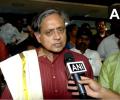
"It is high time India traded dynasty for meritocracy. This would require fundamental reforms, from imposing legally mandated term limits to requiring meaningful internal party elections, together with a concerted effort to educate and empower the electorate to choose leaders based on merit," Tharoor said.

Abhijeet Dipke, founder of the Cockroach Janta Party (CJP), has emerged as a prominent youth leader, transforming a satirical movement into a powerful force that led to the resignation of Union Education Minister Dharmendra Pradhan. Dipke views this as just the beginning, advocating for issue-based politics over identity politics and demanding further reforms in the examination system.

For India, the guiding principle should remain clear: Engage Bangladesh as a sovereign nation and society rather than through the prism of any individual leader or political party, suggests Manoj Mohanka.

Former PepsiCo CEO Indra Nooyi asserts that India and the United States are natural partners, crucial in the geopolitical competition with China. She highlights India's pivotal role as the world's largest democracy with a young, English-speaking population, despite its "chaotic" nature. Nooyi also discusses the need for leaders to understand each other's perspectives to maintain strong bilateral ties.

Thousands of job aspirants in Jharkhand clashed with police during a protest against alleged exam irregularities, demanding a CBI probe and comprehensive reforms in the state's public service commissions.

The Indian government has summoned Meta's global head of public policy after Prime Minister Narendra Modi's Facebook post, addressing youth and promising action against paper leaks, was temporarily removed. Meta attributed the removal to a 'glitch' in its automated content filters, an explanation the government deems insufficient, demanding further discussions.

Prime Minister Narendra Modi addressed the Indonesian parliament, emphasising India's commitment to development over expansionism and advocating for a free, open, and inclusive Indo-Pacific. He highlighted the strong historical ties between India and Indonesia, calling for enhanced cooperation in various sectors, including defence, technology, and counter-terrorism, amidst growing concerns over regional security.
